
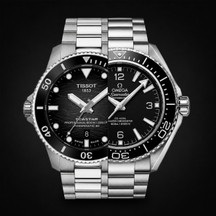
Posted by Sean Mani. on 15th Jul 2026
Tissot Seastar 2000 Professional vs. Omega Seamaster Planet Ocean 600M
Does Spending Nine Times More Really Buy a Better Dive Watch?
Introduction
For decades, the Omega Seamaster Planet Ocean has stood among the elite of Swiss dive watches. With its Master Chronometer-certified movement, exceptional finishing and professional diving pedigree, it has become one of the benchmarks against which modern luxury dive watches are measured.
Yet, quietly sitting elsewhere within the same corporate family is another watch that deserves far more attention than it receives.
The Tissot Seastar 2000 Professional.
At first glance, comparing these two timepieces may seem almost absurd. At the time of writing this article (July 2026), the Tissot retails for CAD $1,325, while the Omega has a retail price of CAD $12,100, with the equivalent configuration (both watches in stainless steel cases and bracelets).
Conventional wisdom would suggest that the Omega must therefore be dramatically superior.
But is it?
Look beyond the logos and marketing campaigns and something fascinating emerges.
Both watches are:
-
Swiss Made
-
Manufactured by brands owned by the Swatch Group
-
Rated to an impressive 600 metres of water resistance
-
Equipped with ceramic bezels
-
Protected by sapphire crystals
-
Built for serious underwater performance rather than desk-diving aesthetics alone.
So the real question isn't whether the Omega is the more luxurious watch.
It unquestionably is.
The more interesting—and more useful—question is this:
Does the Omega Planet Ocean deliver enough additional capability to justify costing nearly eight times as much?
If you're shopping for a professional Swiss dive watch, the answer may surprise you.
Two Brands. One Parent Company.
One of the least-discussed aspects of this comparison is that Omega and Tissot are both owned by the Swatch Group, the world's largest watch manufacturer.
This matters because both brands benefit from shared research, manufacturing expertise and decades of movement development.
While each brand maintains its own identity, engineering philosophy and market positioning, the same parent company oversees everything from entry-level Swiss watches to some of the most technically advanced mechanical movements in production today.
In other words, this isn't a comparison between Swiss engineering and an inexpensive imitation.
It's a comparison between two different interpretations of Swiss engineering—one positioned as accessible luxury and the other as haute horlogerie.
The Numbers Tell an Interesting Story
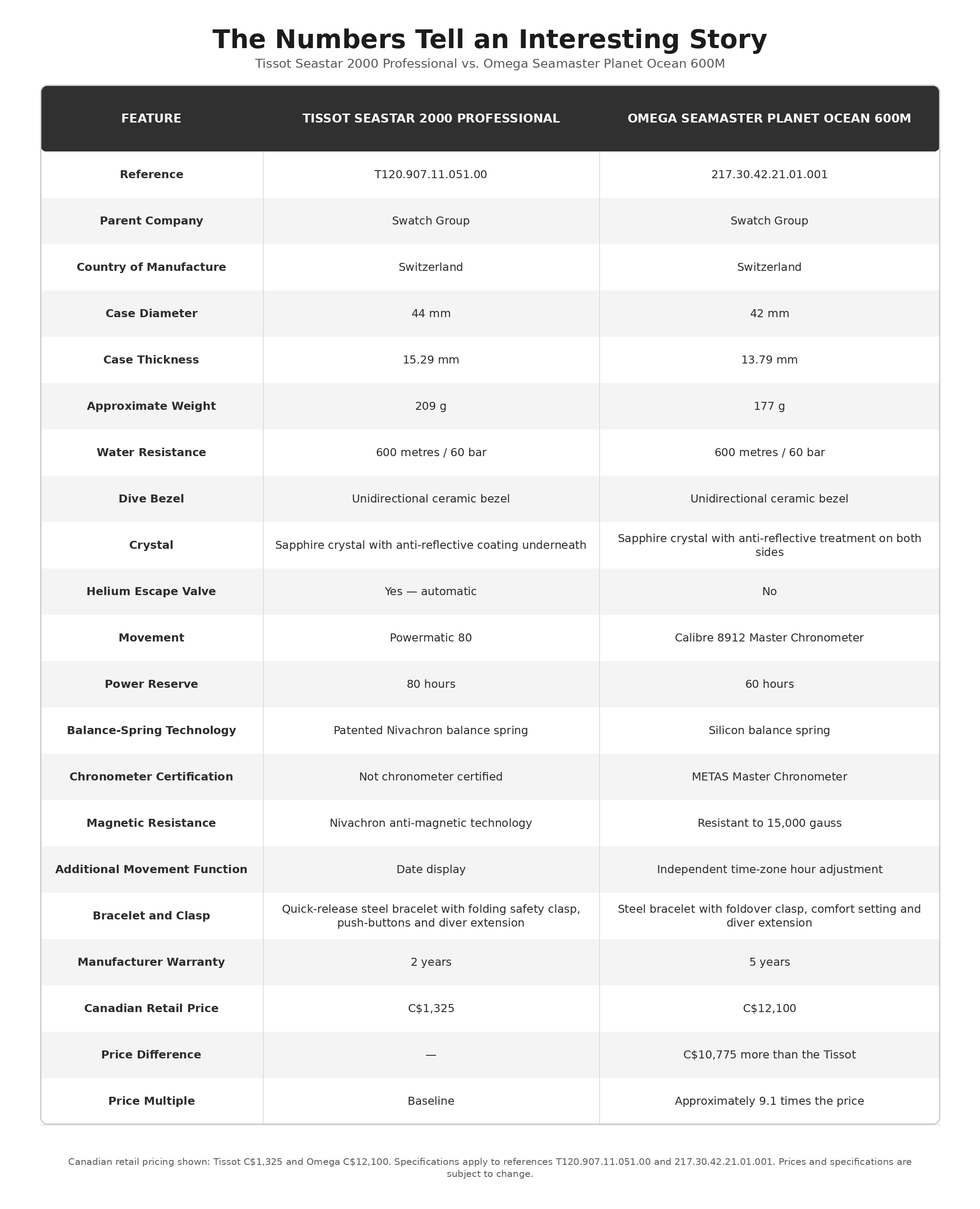
Stop for a moment and ignore the brand names.
Purely on paper, the Tissot is remarkably competitive.
It even exceeds the Omega in several objective categories.
The Feature That Nobody Talks About
Here's something many buyers don't expect.
The Tissot Seastar 2000 Professional offers an 80-hour power reserve.
The latest Omega Planet Ocean delivers 60 hours.
Twenty hours might not sound significant until real life gets involved.
Imagine taking your watch off on Friday evening.
With the Tissot, there's a strong chance it will still be running accurately on Monday morning when you're getting ready for work.
The Omega will typically require winding or resetting sooner.
This doesn't make the Tissot's movement "better." The Omega's Calibre 8912 is a far more sophisticated movement with METAS certification, a co-axial escapement and exceptional anti-magnetic performance.
But it does demonstrate an important point:
A higher price doesn't automatically mean every specification is superior.
The Helium Escape Valve
This comparison becomes even more interesting when we examine one of the most iconic features of professional dive watches.
The Tissot includes an automatic helium escape valve, designed for saturation diving and integrated into its professional specification.
The latest 42 mm Planet Ocean reference takes a different approach. Omega removed the external helium escape valve from this generation, favouring a cleaner case profile while maintaining its 600 m depth rating through its overall engineering.
For nearly every owner, this distinction is academic. Recreational divers will never need a helium escape valve. Saturation diving is a specialized commercial activity.
Still, it illustrates two philosophies:
-
Tissot emphasizes visible professional diving features.
-
Omega emphasizes refined integration and everyday wearability.
Neither approach is inherently right or wrong, but it's a fascinating design divergence.
What Are You Actually Paying For?
This is where the Planet Ocean justifies its reputation.
The additional investment buys far more than a logo.
You receive:
-
Omega's Co-Axial Calibre 8912.
-
METAS Master Chronometer certification.
-
Resistance to magnetic fields up to 15,000 gauss.
-
Twin-barrel architecture.
-
Independent jumping-hour hand for travel.
-
Higher-grade movement finishing.
-
More intricate case and bracelet finishing.
-
Stronger resale performance.
-
One of the most respected luxury sports-watch names in the world.
These are genuine advantages.
The Planet Ocean earns its place among the finest luxury dive watches on the market.
The question is simply whether you will benefit from all of them.
The Law of Diminishing Returns
Luxury watches are governed by the same principle that applies to automobiles, cameras and high-end audio equipment.
The first few thousand dollars buy substantial gains in quality and capability.
Beyond that point, each additional dollar buys progressively smaller improvements.
The Planet Ocean is unquestionably more refined.
Its movement is more technically advanced.
Its finishing is more intricate.
Its certification is more demanding.
Its brand prestige is undeniable.
But none of those improvements increase its water resistance beyond the Seastar's 600 metres.
None extend its power reserve beyond the Tissot's 80 hours.
None make it dramatically more capable as a recreational dive watch.
That is the essence of diminishing returns—and where the Seastar 2000 Professional becomes such a compelling proposition.
Verdict
The Omega Seamaster Planet Ocean 600M remains one of the finest luxury dive watches available today. It combines advanced movement technology, exceptional finishing, outstanding anti-magnetic performance and the prestige of one of Switzerland's most celebrated watchmakers.
It deserves its reputation.
But the Tissot Seastar 2000 Professional tells a different—and equally important—story.
It proves that a modern Swiss dive watch doesn't have to cost five figures to deliver authentic professional capability. With its 600-metre water resistance, ceramic bezel, sapphire crystal, automatic helium escape valve, 80-hour power reserve and robust Powermatic 80 movement, it offers an extraordinary level of engineering for its price.
If your goal is to own one of the most technically sophisticated luxury dive watches ever produced, the Omega Planet Ocean remains a superb choice.
If your goal is to own a serious Swiss professional dive watch that delivers exceptional real-world performance, outstanding everyday reliability and one of the strongest value propositions in modern horology, the Tissot Seastar 2000 Professional is remarkably difficult to overlook.
It doesn't try to be an Omega.
It doesn't need to.
On its own merits, it stands as one of the smartest purchases in Swiss watchmaking today.