
Posted by Sean Mani. on 5th Jul 2026
Baume & Mercier Riviera vs. Audemars Piguet Royal Oak | The Complete Comparison Guide
Two Icons. Two Designers. One Revolutionary Era of Swiss Watchmaking.
"Isn't the Riviera basically a Royal Oak?"
It's a question that appears repeatedly across watch forums, social media, YouTube comments, and conversations between collectors.
At first glance, the comparison seems understandable. Both watches feature angular cases, integrated bracelets, and a distinctly architectural approach to sports watch design. To someone new to luxury watches, they can appear to belong to the same family.
But appearance alone rarely tells the whole story.
The reality is considerably more interesting.
The Baume & Mercier Riviera is not a Royal Oak copy. It is the product of the very same revolutionary period in Swiss watchmaking that transformed the industry forever. Understanding why requires looking beyond photographs and into one of the most exciting decades in horological history.
A Revolution in Steel
Today, the idea of spending thousands of dollars on a stainless steel sports watch seems perfectly normal.
In the early 1970s, it was almost unthinkable.
Luxury watches were expected to be crafted in precious metals. Gold represented prestige. Stainless steel was largely reserved for tool watches and professional instruments.
Everything changed in 1972.
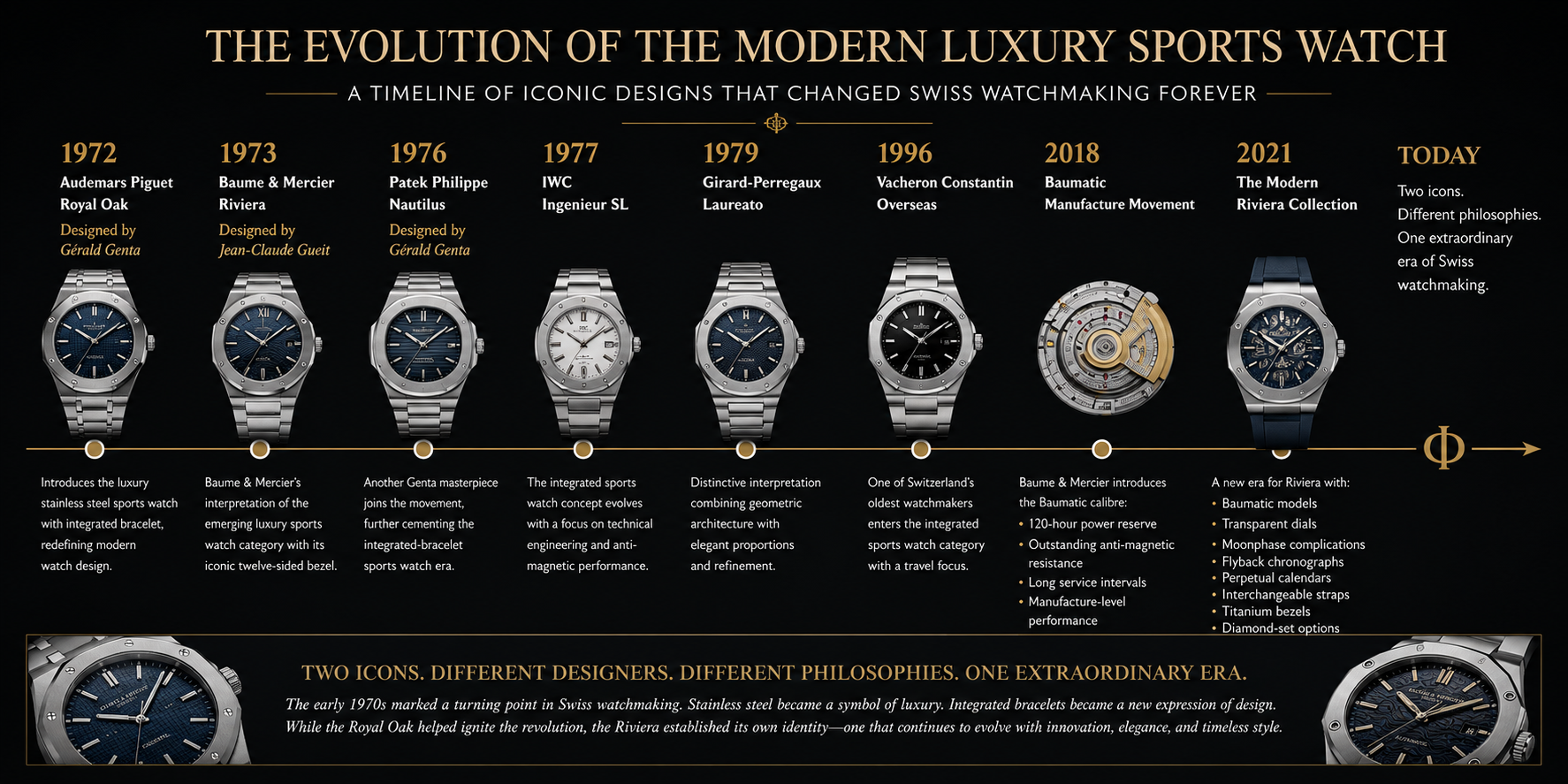
Audemars Piguet introduced the Royal Oak, designed by the legendary Gérald Genta. It challenged conventional thinking by presenting stainless steel as a luxury material while embracing bold geometry, visible screws, and an integrated bracelet unlike anything the market had previously seen.
The watch divided opinion.
Today it is regarded as one of the greatest watch designs ever created.
Yet the Royal Oak wasn't the beginning of a trend—it was the beginning of a movement.
Swiss manufacturers soon began exploring their own interpretations of modern luxury sports watches.
One year later, in 1973, Baume & Mercier introduced the Riviera.
Not as a Royal Oak imitation.
Not as a lower-priced substitute.
But as Baume & Mercier's own vision of what modern Swiss elegance could become.
Two Designers. Two Different Philosophies.
One of the biggest misconceptions surrounding the Riviera is the belief that it somehow borrowed its identity from Gérald Genta.
It didn't.
The Royal Oak was designed by Gérald Genta.
The Riviera was designed by Jean-Claude Gueit.
Those are two entirely different creative minds.
While Genta's Royal Oak embraced industrial sharpness and mechanical boldness, Gueit's Riviera expressed something different.
The Riviera was inspired by the relaxed sophistication of the French and Italian coastlines.
Its twelve-sided bezel suggested movement rather than machinery.
Its proportions were softer.
Its personality was more versatile.
One watch celebrated engineering as sculpture.
The other celebrated architecture through elegance.
Both became enduring icons.
The Riviera's Signature Identity
Every truly great watch possesses features that make it instantly recognizable from across a room.
For the Royal Oak, it is the octagonal bezel and exposed hexagonal screws.
For the Riviera, it is the distinctive twelve-sided bezel that has remained remarkably consistent for more than fifty years.
Over the decades, the Riviera has evolved while preserving that unmistakable silhouette.
Modern references introduce transparent wave-pattern dials, sophisticated colour palettes, integrated rubber straps, manufacture movements, perpetual calendars, moon phases, chronographs, and even smoked sapphire dials that reveal the movement beneath.
Despite these advancements, the watch remains unmistakably a Riviera.
That consistency is one of the hallmarks of great industrial design.
Similar Era. Different Design Language.
Comparisons between the two watches often stop after noting that both have integrated bracelets.
But that's where the similarities begin to fade.
The Royal Oak projects technical confidence.
The Riviera projects refined versatility.
The Royal Oak relies heavily on its octagonal bezel and tapisserie dial.
The Riviera is defined by flowing architectural lines, transparent wave-pattern dials, Roman numerals, polished facets, and Mediterranean-inspired elegance.
Neither approach is better.
They're simply different expressions of the same revolutionary period in Swiss design.
The Modern Riviera Has Become Something More
If you haven't looked at the Riviera collection in recent years, you may be surprised by how far it has evolved.
The introduction of the Baumatic manufacture movement transformed the collection.
Offering an exceptional five-day (120-hour) power reserve, enhanced anti-magnetic performance, and long service intervals, the Baumatic represents one of the strongest technical achievements in its price category.
Baume & Mercier has continued expanding the collection with flyback chronographs, perpetual calendars, moon phases, transparent sapphire dials, and elegant diamond-set references.
Today's Riviera is no longer simply an attractive sports watch.
It is an entire family of modern Swiss luxury timepieces.
Luxury Isn't About Recognition Alone
The luxury watch industry often encourages buyers to pursue recognition.
The most photographed.
The most expensive.
The hardest to obtain.
But true collectors know that great watches are rarely defined by popularity alone.
They are defined by thoughtful design.
Engineering.
History.
Proportion.
Comfort.
Reliability.
Character.
The Riviera excels precisely because it doesn't attempt to imitate another watch.
It possesses an identity entirely its own.
Which Watch Is Right For You?
If you're fortunate enough to own a Royal Oak, you've acquired one of the defining watches of modern horology.
Its place in history is unquestionable.
But that doesn't diminish what the Riviera offers.
The Riviera represents a different philosophy.
It is a luxury sports watch designed to be worn every day rather than admired from a safe.
It offers remarkable Swiss craftsmanship, distinctive architecture, exceptional comfort, and, in Baumatic form, a manufacture movement that rivals watches costing considerably more.
For many professionals, entrepreneurs, executives, travellers, and enthusiasts, that combination makes perfect sense.
Luxury should enrich your everyday life—not spend most of its time in a safe.
Why the Riviera Deserves More Recognition
Perhaps the greatest misunderstanding surrounding the Riviera is that people view it only through the lens of another watch.
Doing so overlooks more than fifty years of independent history.
It ignores the creativity of Jean-Claude Gueit.
It overlooks one of Switzerland's earliest integrated luxury sports watches.
And it misses the remarkable evolution that has transformed the Riviera into one of the most technically impressive collections in Baume & Mercier's history.
The Riviera deserves to be appreciated for what it is—not for what some mistakenly believe it resembles.
Final Thoughts
Great design doesn't exist in isolation.
The early 1970s produced an extraordinary generation of Swiss luxury sports watches that forever changed the way collectors viewed stainless steel, integrated bracelets, and contemporary elegance.
The Royal Oak helped ignite that revolution.
The Riviera helped define its diversity.
More than fifty years later, both remain successful because they stayed true to their original identities.
The Royal Oak continues to be unmistakably the Royal Oak.
The Riviera continues to be unmistakably the Riviera.
And perhaps that's the greatest compliment either watch could receive.
Frequently Asked Questions
Is the Baume & Mercier Riviera a copy of the Audemars Piguet Royal Oak?
No. While both emerged during the early 1970s revolution in luxury sports watch design, they were created by different designers with distinct design philosophies. The Riviera was introduced in 1973 by Jean-Claude Gueit and has maintained its own identity ever since.
Which watch came first?
The Audemars Piguet Royal Oak debuted in 1972. The Baume & Mercier Riviera followed in 1973, making it one of the earliest integrated-bracelet luxury sports watches of the era.
Who designed the Riviera?
The Riviera was designed by Jean-Claude Gueit, whose vision emphasized elegant architecture, versatility, and Mediterranean-inspired styling.
Why does the Riviera have a twelve-sided bezel?
The twelve-sided bezel has been the Riviera's defining design signature since 1973. It gives the watch its instantly recognizable architectural appearance while distinguishing it from other integrated-bracelet luxury watches.
Is the Baumatic movement an in-house movement?
Yes. The Baumatic calibre is a manufacture movement developed for Baume & Mercier, offering a five-day power reserve, excellent anti-magnetic performance, and long recommended service intervals.
Is the Riviera a good everyday luxury watch?
Absolutely. The collection was designed to combine Swiss craftsmanship, everyday comfort, robust water resistance, and timeless styling, making it equally suitable for business, travel, and leisure.
Why choose the Riviera?
For collectors seeking authentic Swiss heritage, distinctive design, outstanding engineering, and exceptional value, the Riviera offers a compelling alternative within the world of integrated-bracelet luxury sports watches.